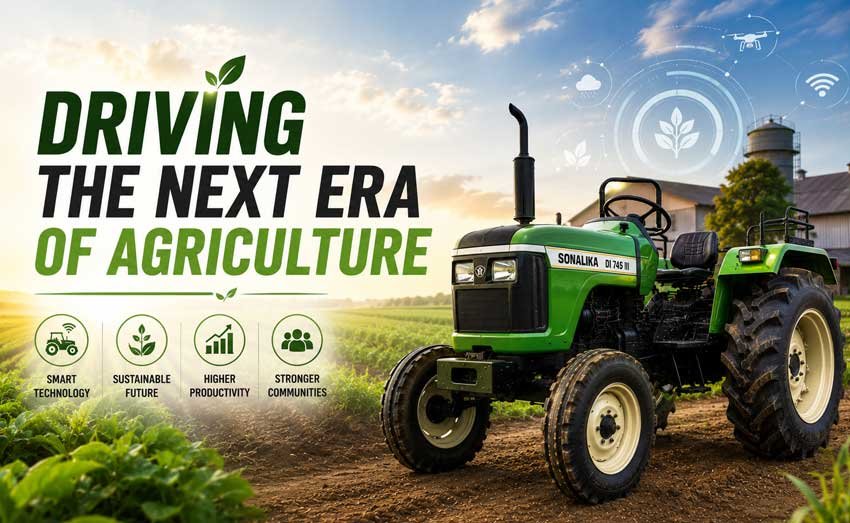
Driving the Next Era of Agriculture
Farmers have relied on tractors for generations, but new models are transforming the industry. Smart, data driven tractors improve accuracy, efficiency, and sustainability across acres of agriculture, from modest family plots near Jaipur to vast agri estates in rural India. No longer are tractors only plow pullers. Improved GPS guidance, auto steer systems, and real time field monitoring allow farmers to plant at the same depth, apply pesticides less often, and use less fuel, boosting yields and lowering costs.
This transformation involves solving real world issues including labor shortages, growing material costs, and changing weather. Farmers can use their phones to monitor performance, arrange maintenance, and maximize field use with smart tractors that connect to farm management software. The information these products provide helps digital farmers make better decisions every season.
In this post we will talk about how the next generation of tractors are changing the way we do things, making them smarter and more efficient with resources and helping Indian agriculture adapt to a changing world.
Smarter Fields, Bigger Harvests: The Impact of Technology on Tractor Power
Today's agriculture uses data, precision, and intelligent design, not horsepower. Modern farm tractors are becoming high tech command centers with innovations to improve efficiency, waste reduction, and acreage decision making in rural Rajasthan and growing agri hubs around Jaipur. Plant and spray with sub inch accuracy using GPS guided auto steer devices, reducing overlap and inputs. Farms with diverse soil conditions over big fields benefit from this accuracy.
Standard telematics in many modern vehicles communicate real time engine data, fuel usage, and maintenance warnings to mobile devices to assist reduce unscheduled downtime during busy seasons. Operators can simply move between ploughing, sowing, tilling, and other tasks on the new operator cabins touchscreen dashboards and implement controls.
Electric and hybrid powertrains are improving, making them quieter and cleaner, which is good for indoor farming or urban farming. Remote diagnostics and over the air software updates are standard on many tractors to keep your equipment updated without frequent maintenance visits.
Farmers can boost their ROI by:
- Regular telematics checkups prior to monsoon seasons
- Annual optimisation of field patterns using GPS data logs
- Help train operators in using multi function dashboards
- These upgrades are not just about convenience, they are about changing how farms scale sustainably.
How Smart Technology is Changing Tractor Operations in 5 Ways
The future of modern farming is being reshaped through high tech innovations and today is tractors are not only diesel powered workhorses but also intelligent, data driven machines that are revolutionising how fields are managed in places like Rajasthan and around the world.
Precision Guidance Systems, Inc.
Advanced GPS and RTK technology allows tractors to minimize planting, spraying, and harvesting overlap with centimeter level accuracy. This improves efficiency, reduces inputs, and promotes sustainable land use, especially in locations where irrigation water is scarce.
Automated Implementation Control
Smart tractors automatically adjust tillage depth, seeding rate and fertiliser application based on real time soil data. This responsive control enables the best crop conditions with the least waste and environmental impact.
Telematics & Remote Monitoring
Farmers can monitor tractor performance, fuel use and location from their smartphone or tablet. The information can be used for preventive maintenance and fleet management, helping reduce downtime during crucial planting or harvesting periods.
AI Driven Field Analysis
In the field, sensors on the machine and machine learning are used to analyse crop health, soil compaction and moisture. Over time this data means smarter decisions for land planning and yield optimisation.
Autonomous Operating Modes
Tractors can do certain repetitive tasks like ploughing or spraying with minimal human involvement through self driving functions. While full autonomy is still being developed, these features are already improving labour efficiency on both large and small farms.
Modern Tractors Moving Sustainable Farming Forward
Today is modern tractors are changing the definition of responsible farming, providing measurable environmental and sustainability advantages to help ensure long term land productivity and regulatory compliance. These machines are powered by precision agriculture, using GPS guided automation, variable rate technology and real time field monitoring to cut chemical overspray, reduce fuel consumption and lower carbon emissions. The tractors of today are designed to perform efficiently on all types of soil and terrain as against the earlier models. It is a very useful feature for the farms in and around Jaipur where water and soil preservation is of utmost importance.
The key benefits of sustainability are:
- Optimised engine performance and auto shutdown features to save fuel
- Use fertilisers and pesticides judiciously to minimise chemical runoff to the necessary areas only
- Controlled traffic farming to reduce compaction and erosion for preservation of soil
- Better resource planning through data driven insights from onboard telematics
- These innovations enable farmers to profitably meet growing consumer demand for eco conscious practices. Smart tractor technology provides agricultural professionals an opportunity to align their operations with regional environmental goals and conservation programs. The drive to future proof farms means equipment upgrades are about more than just horsepower – they’re about sustainability, compliance and smarter land stewardship.
Your Questions About Buying, Servicing and Using Your Tractor Answered
The selection, servicing and operation of farm tractors are faced with a lot of practical considerations in the transition to modern farming. These are the common questions asked which make the process easier for farmers in areas like rural Rajasthan and adjacent agricultural belts.
How do I select the correct size tractor for my farm?
Begin with your big jobs, such as ploughing, tilling, hauling or working with attached implements. Small farms (5-10 acres) often do well with 30-50 HP tractors, but larger operations may require 75 HP or more. Also consider what kind of soil, the slope of the terrain and if you will need 4WD for better traction on uneven or wet ground.
What do I have to do for weekly maintenance?
Check engine oil, coolant and hydraulic fluid levels at regular intervals. Check tires for proper inflation and wear, clean air filters to avoid engine stress. Check for loose bolts and broken belts, especially after working in the field in sandy or dusty conditions, as is common in arid areas.
How often should I service the engine on my tractor?
It is recommended that most diesel powered tractors have the oil and filter changed every 150 – 250 operating hours. In cases where fuel quality is variable, fuel filters should be changed more often. Ensure the radiator is clean so it doesn’t overheat during the hottest summer months.
Can I run multiple tools behind one tractor?
Yes, modern tractors can use a variety of attachments through the three point hitch and PTO system. Make sure the PTO speed (540 or 1000 RPM) and lifting capacity are compatible. Test implement alignment to prevent uneven wear.
How do I make my tractor tires last longer?
Sharp turns at high speeds are dangerous, keep the tyre pressure correct. Dual use use tires rated for both, and slow down on pavement to reduce wear.
What do you do if your tractor overheats in the field?
Stop operations safely and allow the engine to cool down gradually. Turn off only when temperatures are stable. Verify the coolant level and inspect for blocked radiators, a frequent issue in dusty environments. Don't open the radiator cap when it's hot.
Is operator training required to operate a tractor safely?
Yes, definitely. Even the veteran farmer reaps benefits from learning about modern safety features, ROPS and proper hitching techniques. Risk increases when misused on sloped or uneven terrain common to the outskirts of Jaipur.
Learning the basics will make you more efficient, safer and will help you get the most out of your tractor investment. All of this is essential to stay competitive in today is changing farming environment.
Preparing for tomorrow is fields, today
The future of farming equipment is no longer on the far horizon, but being played out in fields in Jaipur, Rajasthan and across the agricultural heartlands of India. Modern farm tractors are getting smarter, more efficient and more adaptive. To stay ahead you have to embrace the innovations that meet the real world demands of farming. Today is advances – from fuel efficient engines to GPS guided precision planting – are addressing core issues such as labour shortages, rising input costs and variable yields.
Here are some practical steps to future proof your operations.
- Evaluate your equipment – where are you inefficient in fuel use, field coverage or down time for maintenance?
- Modular upgrades like telematics or auto steer are a good way to extend the life and capability of existing tractors.
- Go for tractors that can take a number of implements, which is especially useful for mixed crop farms, common in areas like Ajmer Road.
- Test out next gen models at demo days and local suppliers before you buy.
- Innovation is more than simply buying new machines, it is all about making the right decision and being strategic to increase productivity while cutting costs in the long run. The value is not in technology for the sake of technology, but in tools that deliver measurable gains in efficiency, sustainability and profitability.
Take the next step: evaluate your seasonal operations, pinpoint one area for improvement and research equipment solutions that fit your farm is scale and goals. The future of farming isn’t a single breakthrough it is the smart, steady adoption of tools that work for your land, your crops, and your livelihood.